

#Global #MENA #sentiment – A new study which analyses 12,000 articles across 500 global media outlets and surveys 6,300 respondents across 19 markets finds that media coverage about AI is predominantly optimistic. Overall 57 percent of global media coverage is framed positively, but media consistently overstates public excitement in the majority of markets surveyed. The research was conducted by global media intelligence provider Carma using data from 37 markets for January to December 2025. The report finds that CEOs are the single most visible commentator group in AI coverage and the most consistently positive, while audiences prioritise safety, misuse prevention, and cybersecurity concerns that media coverage underemphasises.
Media across the Americas, Middle East and North Africa, and Asia lean more toward narratives about transformation change enabled by AI, in contrast to European media that frames AI more cautiously, portraying conditional, incremental change. Saudi Arabia, China, Brazil, and India emerge as the world’s most pro-AI markets by public sentiment identified by the study.
SO WHAT? – Carma’s study highlights the gap between how artificial intelligence is being sold to the public and how the public actually feels about it. That gap has potential consequences for technology vendors, commercial enterprises, government entities and regulators. If communicators, business leaders, and policymakers build AI narratives around CEO optimism while underserving audience concerns about cybercrime, deepfakes, and misuse, they risk eroding the public trust that AI deployment depends on. The study finds that media consistently overestimates positive sentiment in the majority of markets
KEY POINTS:
Dubai-headquartered global media intelligence provider Carma has published a new study about media and public sentiment towards AI. The research analyses 12,000 articles across 500 global media outlets in 37 markets, and surveyed 6,300 respondents across 19 markets.
Global AI media coverage is 57% optimistic, with the prevailing narrative positioning AI as a productivity driver rather than a source of disruption or doom. The hype cycle focuses firmly on generative AI tools, with ChatGPT, DeepSeek, and Gemini generating the highest media attention volumes in 2025.
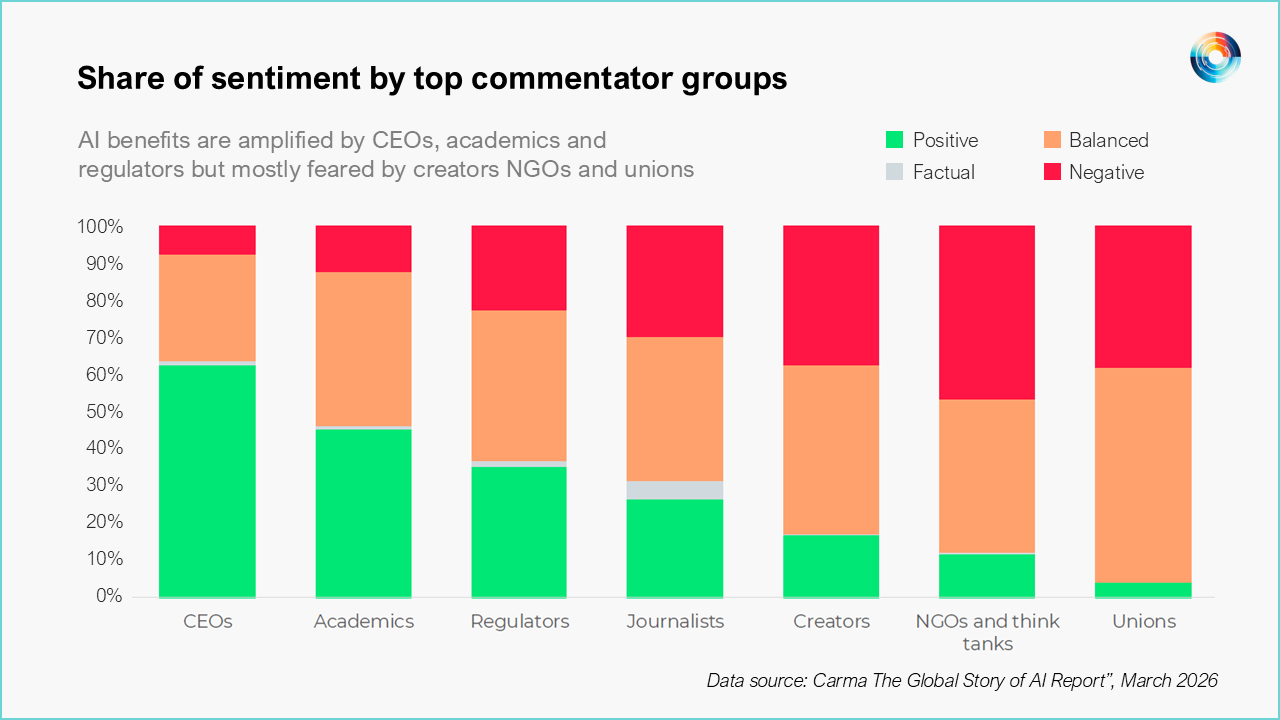
CEOs are the most visible and most positive commentators in AI coverage, featuring in more than one in ten articles. Compared to academics, regulators, journalists, and independent experts, CEOs consistently steer coverage in an optimistic direction. Meanwhile, creators, NGOs, and unions are the groups most likely to frame AI negatively.
The research found that critical narratives are gaining ground over time, particularly around two themes: AI needing stronger guardrails and the escalating AI arms race. Higher levels of positive sentiment tends to follow model launches, major conferences, and investment announcements, suggesting optimism is event-driven and potentially fragile.
A clear media-audience gap exists on drivers of trust. Media emphasises accuracy and reliability as the foundations of AI trust. Audiences, by contrast, rank safety and misuse prevention even higher and place greater weight on transparency than media coverage reflects. On the distrust side, audiences fear cybercrime, hacking, fraud, deepfakes, and election interference far more than media coverage suggests.
The study found that the dominant fear in media is not robots, it is loss of human control. This narrative grew in prominence throughout 2025 and is now the leading distrust signal in AI coverage. Governance discussions attract significant negativity, particularly around regulation, accountability, and liability.
Regional media sentiment diverges sharply from region to region. The Americas, MENA, and Asia frame AI predominantly as transformational, with roughly two thirds of coverage portraying AI-driven change as structural and economy-wide. Europe is notably more cautious, with only half of coverage characterising AI as transformational. Nearly 60% of European media portraying AI risks as medium or high impact, compared to around 40% in MENA and Africa.
Saudi Arabia, China, and South Korea record the highest combined trust and excitement levels among audiences surveyed in 19 countries. That public sentiment closely mirrors the optimistic tone of domestic media coverage. In contrast, the study categorises Canada, France, Italy, and Japan as AI-anxious markets, with higher fear and lower excitement levels.
Business adoption dominates enterprise AI coverage, generating nearly ten times more media attention than talent disruption narratives. Coverage focuses heavily on operational efficiency and optimisation, rather than long-term societal transformation in healthcare, education, or scientific research.
In the investment front, speculation about an AI investment bubble exists, but is outweighed by sustained capital commitment signals.
Responsibility for AI’s direction is shifting toward AI companies and corporate users, with governments and regulators remaining important, but no longer seen as the primary accountability holders. On the other hand, public sector AI deployment attracts comparatively higher negative sentiment, reflecting governance and accountability concerns when AI operates at state level.
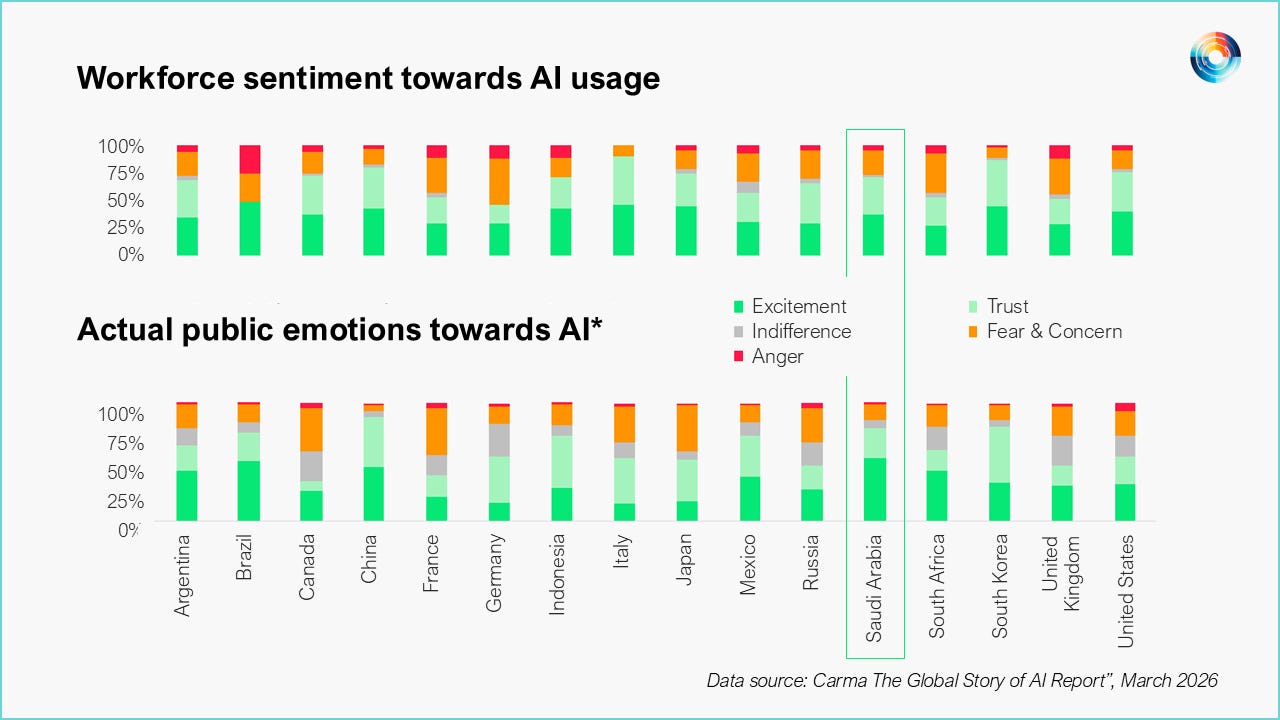
FOCUS ON KSA - Saudi Arabia emerges as one of the most AI-optimistic markets in Carma's March 2026 AI perceptions report, with the Kingdom’s public excitement toward AI running 20 percentage points above the global average and fear running 6 percentage points below it. Saudi media consistently portrays AI primarily as a transformational opportunity, with coverage built around automation, decision support and investment narratives rather than risk or disruption. The finding is broadly consistent with global media patterns, though with AI risks characterised as low-to-medium impact.
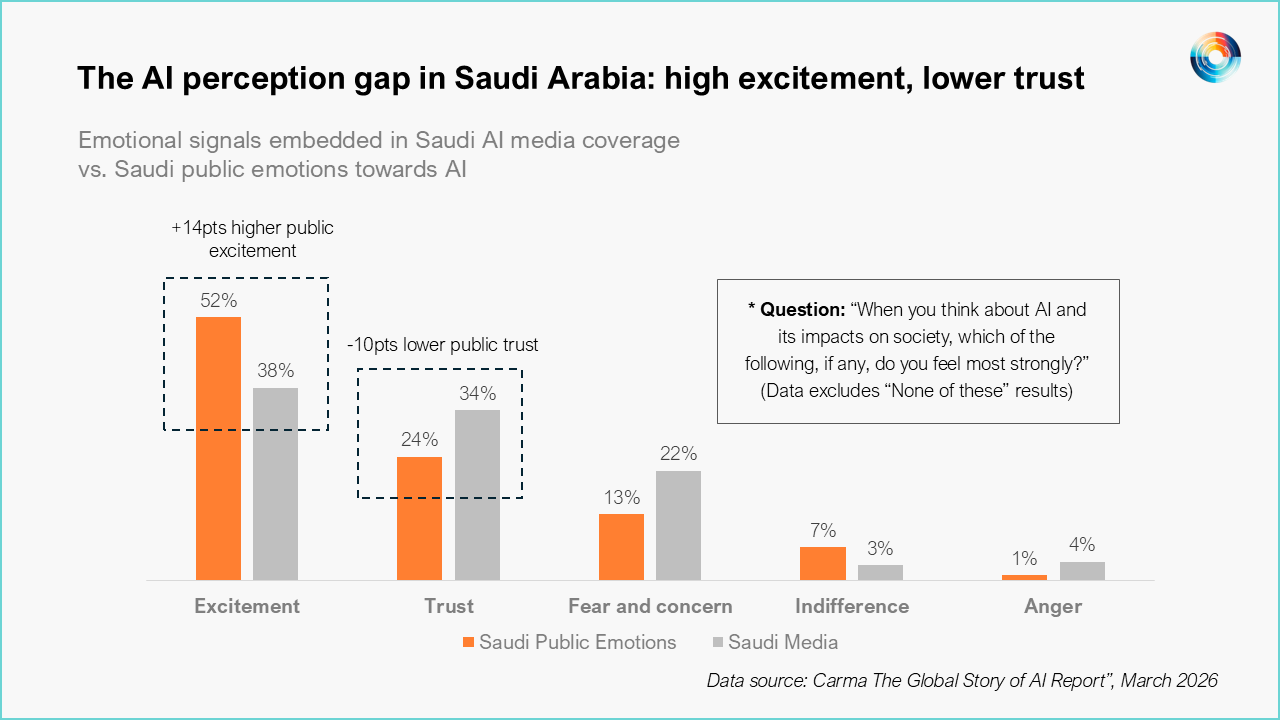
The report also identifies a notable perception gap between Saudi media and the Saudi public. Saudi public excitement about AI is 14 percentage points higher than excitement reflected in Saudi media coverage, while public trust in AI runs 10 percentage points below the trust level portrayed by Saudi media. The trust gap suggests that public enthusiasm is outpacing confidence in how AI is actually being governed and deployed. The report shows a disconnect between what drives trust among Saudi audiences (transparency about how AI works was cited by 28% of respondents as the strongest trust driver) and what Saudi media emphasises, which focuses more heavily on accuracy and safety.
LINK
The Global Story of AI - Report (Carma)
Read more about AI sentiment and adoption research:
Middle East workers lead the world on AI adoption at work (Middle East AI News)
85% of UAE CIOs say role at risk over AI delivery (Middle East AI News)
Four in five Gulf organisations embed AI into strategic plans (Middle East AI News)
UAE organisations edge past global peers in AI leadership (Middle East AI News)
GCC tax leaders prioritise AI quality over efficiency (Middle East AI News)