

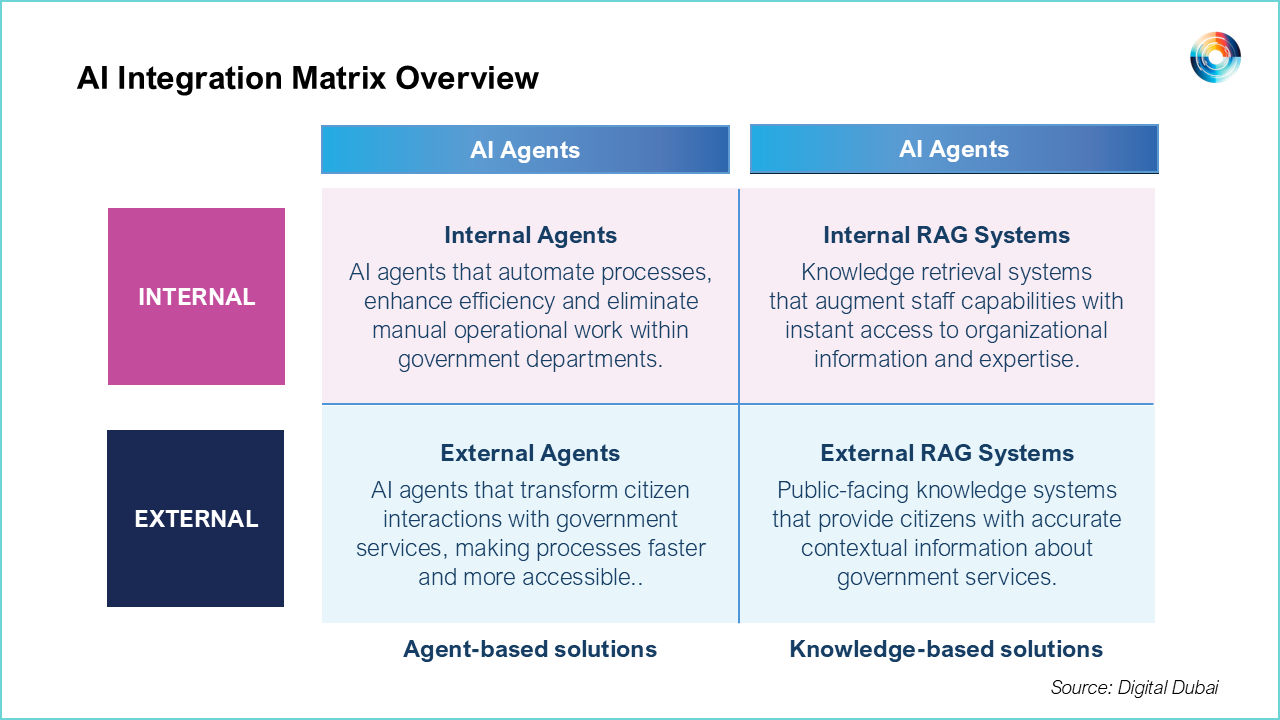
#Dubai #digital transformation — Digital Dubai has introduced an AI Integration Matrix Framework, to guide Dubai Government entities moving from fragmented AI pilots toward a fully integrated, coordinated AI ecosystem. Released via a whitepaper this week, the framework classifies all government AI use cases into four quadrants internal agents, internal RAG systems, external agents and external RAG systems. The methodology gives public sector leaders a practical tool to prioritise investments, eliminate duplication and deploy AI coherently across both back-office operations and citizen-facing services. The framework has already been applied internally at Digital Dubai, guiding the deployment of more than 100 AI systems across multiple sectors.
SO WHAT? — Most government AI programmes share the same structural weakness: isolated pilots that deliver local results but fail to add up to systemic change. The risk of weak outcomes is magnified when AI implementation is accelerates and Digital Dubai’s AI Integration Matrix is a direct response to that problem. By making it easy to classify every AI initiative it gives government entities a shared language, a prioritisation methodology and a roadmap for scaling AI coherently. In addition, the fact that Digital Dubai has already validated the framework across 100-plus live deployments gives it practical credibility that a whitepaper would lack on is own.
KEY POINTS:
Digital Dubai has introduced an AI Integration Matrix Framework for government AI projects, publishing a whitepaper providing government entities with a structured, four-quadrant model for classifying, prioritising and deploying AI initiatives. The methodology covers both internal operations and citizen-facing services in a coordinated, integrated manner.
The framework has already been deployed internally at Digital Dubai, guiding more than 100 AI systems. The implementation improved visibility of AI initiatives, strengthened coordination among teams and reduced project overlap, validating the model in a live government environment before its wider release.
The framework is built around two core dimensions: the nature of the technology deployed (either autonomous agents or retrieval-augmented generation systems) and the scope of deployment (either internal to government operations or external facing citizens and the public).
Four strategic quadrants define the complete AI ecosystem:
Internal agents that automate back-office operations and staff workflows;
Internal RAG systems that give employees fast access to institutional knowledge and policies;
External agents that automate public service delivery and citizen transactions;
External RAG systems that provide real-time public information and personalised guidance.
The framework addresses one of the most common challenges facing government AI programmes: where to begin with AI adoption. Digital Dubai’s shared methodology provides structured prioritisation methodologies, gap analysis tools and a roadmap development process that sequences initiatives based on strategic objectives and available resources.
Data quality and governance are identified as foundational enablers, with the whitepaper emphasising that successful AI implementation depends not only on models and applications but on systematic data management, accuracy, reliability and adherence to ethical and regulatory frameworks.
Digital Dubai describes the framework as a shift from adopting AI to embedding it across a fully integrated government ecosystem, building a government that operates as one interconnected system with people at the centre.
The AI Integration Matrix has been designed as a globally adaptable model, offering a methodology that can be tailored to different government contexts while maintaining core principles of integration and balance. Digital Dubai is increasingly becoming a source of exportable government AI governance thinking for public sectors worldwide.
ZOOM OUT — The AI Integration Matrix Framework builds on institutional foundations and agile processes that Dubai has been assembling systematically over the past few years. In 2023, Dubai launched the Dubai Centre for Artificial Intelligence to coordinate AI adoption across government entities. In 2024, the Dubai Universal Blueprint for Artificial Intelligence aligned all emirate AI initiatives under a single strategic plan, followed by the appointment of 22 Chief AI Officers across government departments. Last year, Dubai Crown Prince HH Sheikh Hamdan bin Mohammed bin Rashid Al Maktoum approved the formation of the Dubai AI Acceleration Taskforce, bringing together those chief AI officers from 27 government entities under a coordinated framework. The AI Integration Matrix provides a shared methodology to take government AI projects from strategy through implementation
[Written and edited with the assistance of AI]
DOWNLOAD
Read more about Dubai Government’s AI initiatives:
Digital Dubai launches AI+ to train 50,000 government staff (Middle East AI News)
Dubai announces task force to accelerate AI adoption (Middle East AI News)
2nd Dubai AI Government Services Accelerator (Middle East AI News)
Dubai;s human-AI collaboration classification (Middle East AI News)
Dubai launches AI Academy to train 10,000 leaders (Middle East AI News)