

#UAE #workforce - The Department of Government Enablement – Abu Dhabi (DGE), the emirate’s public-sector transformation body, has published a new workforce report: “Light Workforce Paradox”. The new study argues that as AI takes over routine work, the people left carry more weight. Its foresight study maps four work scenarios to 2040 and backs “Symbiotic Craftsmanship”, where AI works in the background and humans keep final judgement. The report also urges organisations to define who is accountable for AI-assisted decisions.
SO WHAT? - Abu Dhabi has 30,000 civil servants, a 2027 deadline and a theory that fewer tasks means heavier decisions to be carried by human workers. The report argues that as AI absorbs routine work, people make fewer decisions, and each one carries greater responsibility. the “Light Workforce Paradox”. If the decisions that remain become more consequential, then this calls for new governance, management and accountability rules.
KEY POINTS:
The Department of Government Enablement – Abu Dhabi (DGE), has published a new report on AI and the workforce called “Light Workforce Paradox”.
The new study argues that since AI cuts task volume and headcount, it also raises the strategic weight of human judgement. Oversight, exception-handling, ethical calls and responsibility for outcomes all grow in importance as AI expands what institutions can do.
The DGE’s report sets out four scenarios for the period until the year 2040, which are shaped by two uncertainties: how fast AI automation advances and how far people trust it. The four scenarios are: Symbiotic Craftsmanship, Fluid Human Core, Stalled Symbiosis and Forced Automation.
Symbiotic Craftsmanship is the preferred future described in the report. This is where AI absorbs administrative burden, while people keep judgement, nuance, creativity and relationship management. The Abu Dhabi report asserts that this won’t happen by default and is a path that has to be chosen, designed for and sustained by organisations.
The two low-trust scenarios carry clear costs. The Stalled Symbiosis scenario sees AI tools fail to scale and morale erode, while the Forced Automation scenario delivers efficiency gains but damages workforce cohesion, accountability and public confidence in institutions.
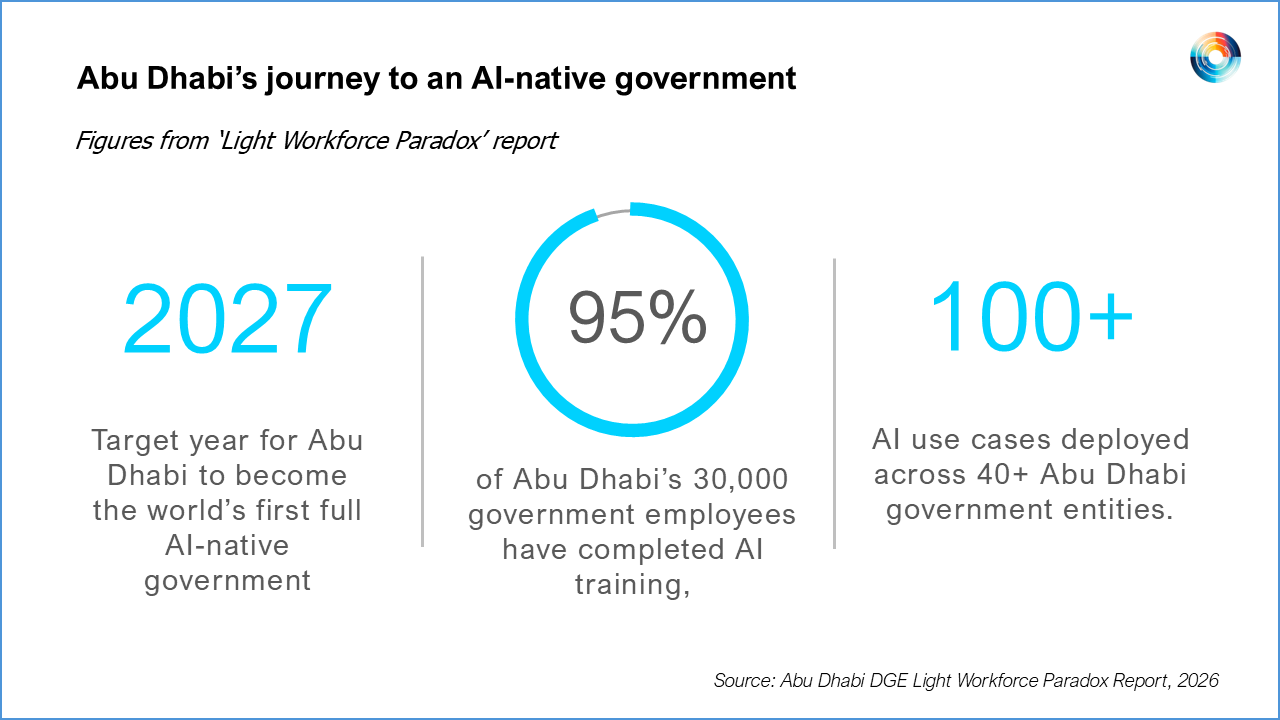
Over 95 per cent of Abu Dhabi’s 30,000 government employees have completed AI training. The emirate has more than 100 AI use cases running across over 40 government entities, while every public entity has a Chief Digital and AI Officer.
Microsoft’s Global AI Diffusion Report for Q1 2026 ranked the UAE first in the world for AI adoption among working-age people. Abu Dhabi aims to become the first fully AI-native government by 2027.
Five early moves are recommended: a standard naming an accountable person for key public decisions, role redesign pilots in high-stakes services, an audit of AI support across entities, training that rewards challenging AI outputs, and a public trust dashboard.
Risks highlighted by the report include erosion of human judgement through over-reliance on AI, uneven access to AI tools, poorly designed tools that add cognitive load, and blurred accountability when humans and machines co-produce outcomes.
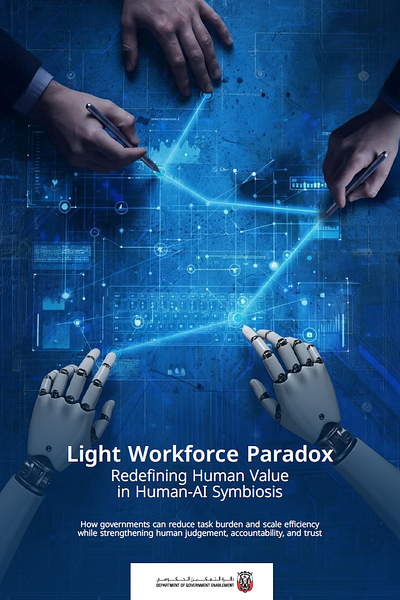
The findings draw on a scan of more than 140 global trends, a three-stage Delphi process, and workshops with government practitioners and academic and international experts. The full report is titled “Light Workforce Paradox: Redefining Human Value in Human-AI Symbiosis”.
[Written and edited with the assistance of AI]
Source: Abu Dhabi Department of Abu Dhabi Enablement
Download
Read more about AI’s effect on the workforce:
82% of GCC professionals use AI weekly, few are AI-trained (Middle East AI News)
Workday opens Dubai office, cites 90% AI use (Middle East AI News)
AI is adding to Gulf workloads, survey finds (Middle East AI News)
Dubai government adopts productivity system (Middle East AI News)
Middle East workers lead the world on AI adoption at work (Middle East AI News)